


Don James and the Invisible Work in Photography

Updated: Sep 30, 2025

Many of us remember when photography was safest in the hands of professional photographers. They had the endlessly adjustable equipment, from manual focus to elaborate setups of lights and reflectors. Uncle Fred could take a photo of the family assembled on the couch, but we wouldn't trust him for a polished portrait or a perfect art photo of the sunset. In addition to the pro equipment, photographers of yore would spend hours in the darkroom developing film, and printing and adjusting prints. Most folks didn't know how to dodge and burn, nor did they have the darkroom or the chemicals to print photos themselves.
Digital cameras have put decent photography into the hands of many more people, but the gap still exists between the average citizen and the professional photographer. And while having a well-tuned and artistic eye is crucial for finding a compelling subject and framing it in the camera's viewfinder for maximum effect, equally important for many art photographers these days is knowledge of image manipulation software such as Photoshop.
Consider Don James, the photographer on view now at the Clubhouse in Meadowbrook Park. His piece "Roots" was shot quickly and finished slowly. "A lot of the photos I take are almost point-and-shoot," he says. "There is something I see that catches my eye and I can't tell what it is. I've been doing it long enough that it's just intuitive. I know what I want in the frame, and I don't ponder it too much. I really don't know what I'm looking for until I get back into the studio and edit it.

"For 'Roots,' we were on a family hike and I may have spent all of six seconds on taking it. I probably took a couple of shots really quickly, and that's it. The roots weren't going anywhere; it wasn't going to change. But I did a few shots to make sure I got what I wanted to capture. It took me six seconds to create the image of 'Roots' in my camera. But the backend took hours. Quite a bit of labor is in that stage. For the printing, I went to a friend's house who had an archival inkjet printer and we spent hours on it. Incidentally, the type of paper you print on really has an impact of the image. It changes the mood of the how the image looks."
Transposing a piece of music into a different key can change the mood of a song. This analogy is fitting when discussing James' work, as he is also a musician. "I am a composer of electronic music," James says. "I was really into synthesizers in high school and college--the old school synths, like the ARP 2600. I am back making electronic music, but I've calmed down a little bit so I like the more serene aspects of the more ambient stuff."
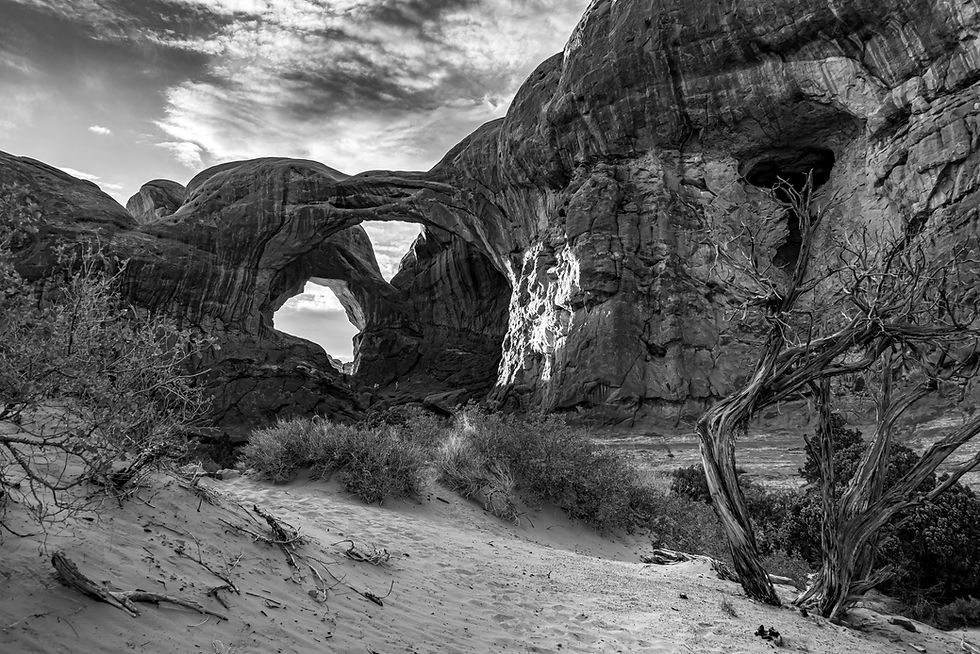
James reports that music and photography present two different sides of his personality. "They are two completely different beasts," says the artist. "Composing music is very deliberate. In photography I am not quite as deliberate." He can and sometimes does prepare carefully to get the perfect shot with his camera. "When I took "Under the Double Arch" at Arches National Park, I spent 45 minutes framing the shot. Then I sat and waited a half hour until the lighting was right. There's a black-and-white photographer named Clyde Butcher who is the Ansel Adams of Florida. I visited his studio in the Everglades last April. He sets up with a view camera and sits there until the sky is perfect. I approached the Arches image the same way Butcher would approach the Everglades."
In contrast, his snap "Tourists" was quite spontaneous. The photo of two women sightseeing in New York City won the Best People and Portraits of People award in last year's Art of Photography show and contest run by the Prairie Village Arts Council. "'Tourists' was classic street photography," says James. "You really don't think about it. You just see it and try to capture what's there." Sometimes inspiration hits, even when it may be less than convenient, as in "West Façade of Kauffman Center."

"One of my goals is to take a photograph that has never been taken before. I've photographed the Kauffman Center dozens of times. All of my attempts showed what all photographers take at that location. Except one. That photo is of the west side of the Kauffman, straight on. No perspective. It just looks like a nautilus shell. I pulled over and took that shot in the middle of Broadway with cars zooming all around me."
One more thing that is interesting about James' process: He takes all his photos in color, even the ones that he will print in black-and-white. Once again, it's the magic of post-production that makes this possible--and makes a good photo better. When an image is opened in Photoshop, the user can see that the software organizes the basic colors in channels, similar to the way that color printing used to have colors separately printed on the image to create the whole color scheme. There's a red channel, a blue channel, etc. Even after you convert a color image to black-and-white in Photoshop, those channels remain. James can boost the intensity of any or all of the channels to create different effects. Items that are bluish can become more intense--not more blue, because it's black-and-white, but more prominent. "That's probably the strongest feature of what I do in terms of production work," James says. "It changes the way the image presents."

And to tie it all back together, James uses another analogy to music. "When you make a record, you record the music and then there's the process called mastering. It takes the product and turns it into the finished product so it is ready for the CD player or turntable. It's the last creative step and the first step in the manufacturing process." The result is an image as sweet as music, thanks to the knowledge and experience of an artist such as Don James.
See a selection of James' photographs now through Nov. 8 at the clubhouse in Meadowbrook Park. The exhibitions are organized by the Prairie Village Arts Council.


Comments